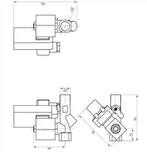
Pneumatic solenoid valve is a kind of industrial equipment for electromagnetically controlling fluid. Pneumatic solenoid valve is a kind of solenoid valve. It blocks the oil hole by controlling the movement of the valve body, generates pressure to promote the work of the piston, and then uses the electromagnetic current to control the entire electromagnetic valve. operation of the valve. Pneumatic solenoid valve can also work normally in vacuum and negative pressure environment. So what are the types of pneumatic solenoid valves?
There are many ways to classify solenoid valves:
1. According to the operation method, there are two types: direct-acting type and pilot-operating type.
2. According to the structure, there are three types: sliding column type, cut-off type and coaxial cut-off type.
3. According to the sealing form, there are two kinds of elastic sealing and gap sealing.
4. According to the number of ports and the number of positions: there are 2-position 2-way, 2-position 3-way, 2-position 4-way, 3-position 3-way, 3-position 4-way, 2-position 5-way, 3-position 5-way, etc. Among them, the 3-position valve is divided into three types: central pressurization, central closing and central exhaust.
Several common classification methods are introduced:
1. Direct type:
The direct-acting solenoid valve uses electromagnetic force to directly push the valve stem (spool) to change direction. According to the control mode of the valve core reset, there are two kinds of single electric control and double electric control. Single electric control uses spring reset, and double electric control uses electromagnetic reset. Direct acting solenoid valve is characterized by compact structure and high commutation frequency. Now the more common direct-acting solenoid valves are mostly small 2-way valves.
2. First type solenoid valve:
The special solenoid valve is composed of a small direct-acting solenoid valve and a large air control valve, also known as an electronically controlled reversing valve. According to the source of the pneumatic control signal of the pilot solenoid valve, it can be divided into two types: self-control (internal pilot) and other control (external pilot).
3. Elastic seal:
Elastic seal refers to a valve that is sealed with elastic materials such as polyurethane to ensure the isolation of each cavity of the solenoid valve, which is called an elastic seal valve. This kind of hair has the characteristics of good wear resistance, low processing precision and good compactness, so it is widely used in various industries.
4. Metal seal:
The so-called metal seal actually means that there is no seal between the valve body and the valve core, and the sealing effect is achieved by the precise cooperation between the valve body and the valve core. This kind of valve requires very high machining accuracy. Its advantages are that the valve has a fast response time, high operating frequency, and where high-speed reversing is required, the disadvantage is that there is a slight leakage.
5. According to the number of ports and positions:
The switching state of the directional control valve is called "position", and several switching states are called several-position valves (such as 2-position valve, 3-position valve). The rest position of the valve (that is, the state when no control signal is applied) is called the zero position. The zero position of the solenoid valve refers to the state when the power is turned off.
The switching state of the valve is determined by the working position of the spool. A spool with 2 working positions is called a 2-position valve, and a 2-position valve with 2 ports is called a 2-position valve.
It is a 2-way valve, which can realize the on or off of the gas circuit. A 2-position valve with 3 ports is called 2-position 3-way. In different working positions, P, A communication, or A, O communication can be realized. Commonly used are 2-position 4-way valve and 2-position 5-way valve.
A valve with 3 working positions on the spool is called a 3-position valve. When the spool is in the middle position, each port is in a closed state, which is called an intermediate closed type; if all the outputs are connected to the exhaust port, it is called an intermediate pressure relief type, and if all the output ports are connected to the input port, it is called an intermediate pressure relief type. It is an intermediate pressurized type.
Pneumatic solenoid valves are divided into different pneumatic solenoid valves according to different structural forms. Among them, the commonly used pneumatic solenoid valves include direct-acting, special-type, elastic sealing and metal-sealing types. Everyone needs to figure out their own when purchasing. Demand, do your homework in advance, and you will make fewer mistakes when purchasing.